We present a field notebook to explore Salamanca’s greener side—a city that is not only golden stone and academic heritage, but also landscape, freshness, and plant life. Amid its historic streets and monumental squares, the city hides a network of gardens, orchards, and riverside walks that tell stories of history, tradition, and sustainability.
A walk between stone and nature
The new Heritage Gardens and Orchards Route is an invitation to discover Salamanca at its most intimate: a field notebook that guides travelers through ten unique sites, from the romantic Huerto de Calixto y Melibea to the serenity of the riverside walk along the Tormes.
Each stop is a haven of beauty: centuries-old shade, the fragrance of flowers, murmuring fountains, viewpoints that open onto wide horizons. Spaces that were once monastic, academic, or communal, and that today unfold as urban oases for strolling, reading, resting, or simply contemplating.
In addition, as a complementary note, we include an annex of private and distinctive orchards that enrich Salamanca’s green map. Places that, while not part of this official route, complete the story of a city that beats between stone and nature.
To discover Salamanca is also to discover its green pulse. Let yourself be guided, take your notebook, and set out on this route where heritage becomes nature.
Ten corners of nature
FIELD NOTES
A romantic garden in the historic center, located beside the city walls with views of the River Tormes. It is linked to the famous work La Celestina, and today it is a place for strolling, resting, and contemplation.
A green space once linked to the former Convent of La Merced, later transformed into a public garden in the heart of the historic center. Its layout recalls the tradition of Salamanca’s convent gardens.
A green corridor that follows the course of the River Tormes, with pedestrian and cycling paths. The slopes of San Vicente Hill add historical and archaeological value, as this was one of the city’s earliest settlements.
Located on land that once belonged to the Franciscan convent, it preserves the memory of monastic life. Today, it is a central park, frequented by walkers and students.
Created at the beginning of the 20th century, it is one of Salamanca’s historic parks. It features a pond with waterfowl and tree-lined areas, forming a small ecological haven in the city center.
The city’s largest urban park, featuring wide tree-lined avenues, sports areas, and relaxation zones. Its design makes it a key space for biodiversity and everyday life in Salamanca.
Set on the grounds of a former Franciscan convent, this park keeps the memory of monastic life alive. Today, it is a lively green space in the city center, enjoyed by walkers and students alike.
One of Salamanca’s most iconic spots, located opposite the New Cathedral. Its expansive garden area, with lawns and trees, offers one of the city’s best monumental views.
A natural corridor that embraces the city and lets you discover Salamanca through the serenity of the river that has accompanied it for centuries.
A living garden where botany, landscape, and tranquility come together to create one of Salamanca’s most special places.

THE RHYTHM OF THE LANDSCAPE
The seasons of Salamanca

The parks and orchards burst into tender shoots, flowers, and fragrances. Unamuno’s vine turns green again, almond and plum trees dress in white and pink, and the riverside walk fills with birds as the river joins the heartbeat of the city.

The city takes refuge in the shade of plane trees, elms, and lindens. Parks become spaces for rest and gathering, while the riverside vegetation along the Tormes cools the air with its lush greenery.

The city is painted in ochre, gold, and red tones. Parks transform into ever-changing canvases, and the wind carries leaves that carpet the pathways. Soft light highlights the golden stone of the monuments.

The gardens draw inward and take on a more subdued character: bare branches, monumental trunks, and a vegetal silence that is also part of the life cycle. The winter calm invites us to await the rebirth of spring.
GARDENS
ORCHARDS
ADDITIONAL GREEN SPACES
Private gardens and orchards
Although they are not part of the route managed by Turismo de Salamanca, these spaces are true green refuges, rich in history and memory. Some can be visited for a small admission fee.
Convent Orchards
Gardening traditions that still breathe within the walls. The most famous are those of Las Úrsulas, Las Adoratrices, and Las Dueñas. These private spaces preserve horticultural traditions in the heart of the city within the religious communities.
The University sequoia
In the landscaped courtyard of the historic University of Salamanca building stands an impressive sequoia, one of the city’s most remarkable botanical specimens. A silent giant planted in the 19th century, it is a symbol of endurance and memory.
Unamuno’s vine
A tree full of literary significance, linked to the daily life of the writer. It is located at the Casa de Unamuno and is so large that it extends onto Calderón de la Barca Street, visible on the way to the New Cathedral. Its literary shade still shelters memory and words.
For the more adventurous
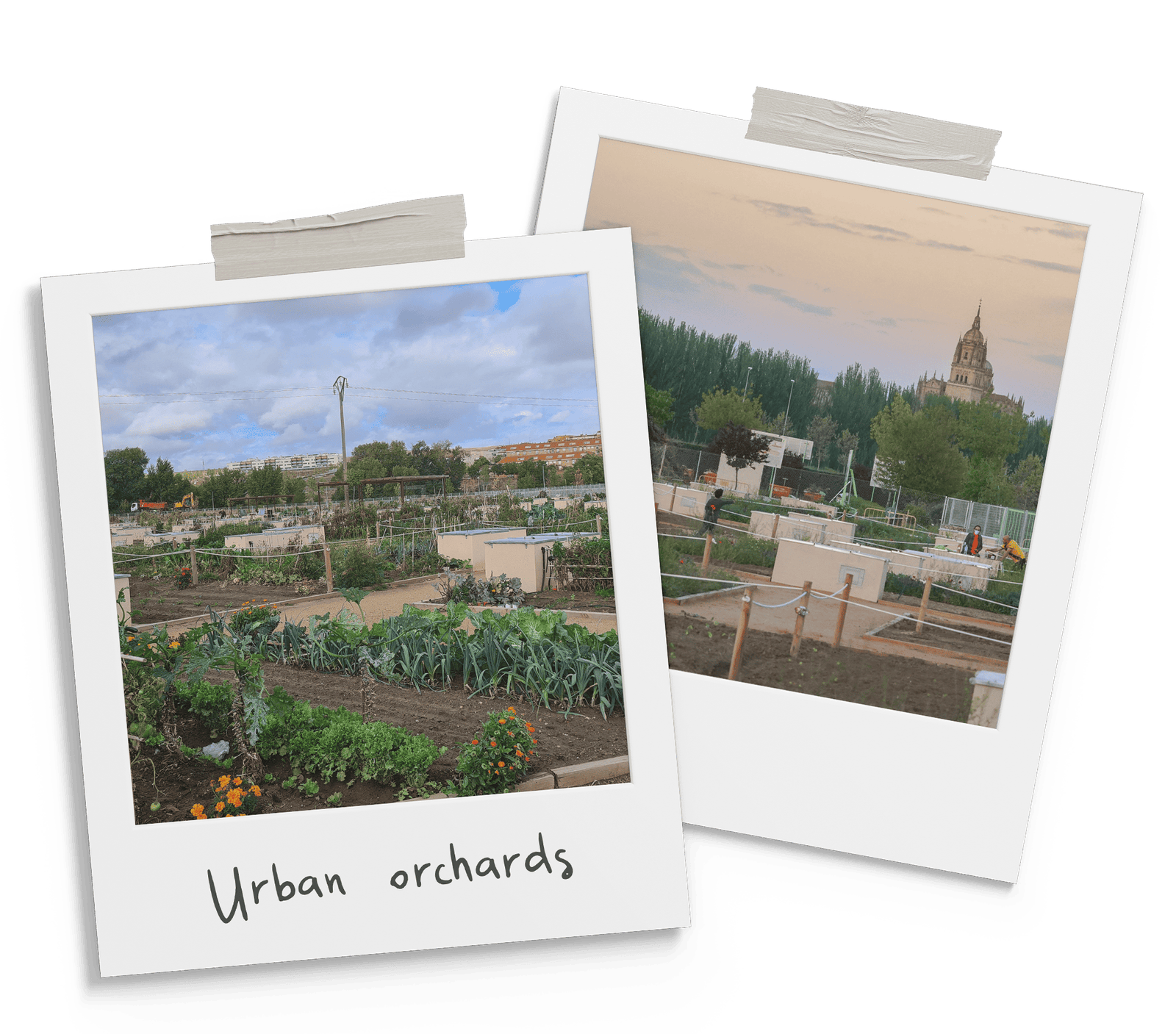
Following the path of the River Tormes toward the Tejares neighborhood, you can visit the new urban orchards and the market hall. These urban orchards have been created as environmental education spaces for citizens, who actively participate in the process of urban naturalization and allow locals to connect with nature. You can reach them via the bike lane or by taking a walk along the parallel path.